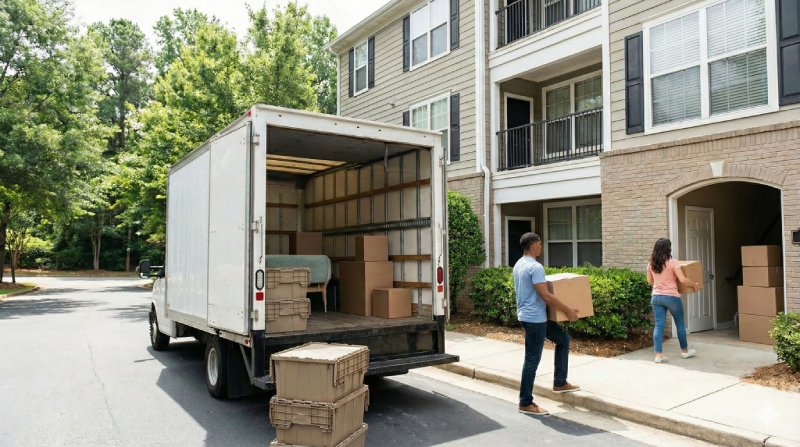
A moving labor hours calculator helps you estimate the time and cost for your move by considering home size, crew configuration, and factors like stairs and distance. This article explains how to calculate both clock-hours (actual time on-site) and labor-hours (total work capacity), interpret baseline estimates by home size, and adjust for real-world factors that commonly double moving time. You'll learn to choose the right crew size, prepare effectively to reduce hours by 30%, and avoid the planning mistakes that lead to costly overruns.
How to Estimate Moving Labor Hours Using This Proven Method
Understanding the difference between clock-hours and labor-hours forms the foundation of accurate moving estimates. Clock-hours represent the actual time your crew works on-site, which determines how long you'll need to reserve parking, elevators, and your own schedule.
Labor-hours multiply clock-hours by crew size, giving you the total work capacity needed. For example, three movers working for four hours equals 12 labor-hours of work capacity, which explains why adding movers can reduce your total moving time.
The calculation method starts with your baseline hours determined by home size and crew configuration. From there, you add specific time adjustments for stairs (about one hour per flight), carry distance factors, and any drive time between locations.
This systematic approach prevents the common mistake of underestimating factors that often double moving time. Professional moving companies use similar formulas internally, though they rarely share the transparent methodology you're seeing here.
Average Moving Hours by Home Size Reference Table
- Under 800 square feet: 2 hours with 2-person crew, 2 hours with 3-person crew
- 800-1000 square feet: 2 hours with 2-person crew, 2 hours with 3-person crew
- 1000-1500 square feet: 3 hours with 2-person crew, 2-3 hours with 3-person crew, 2 hours with 4-person crew
- 1500-2000 square feet: 4 hours with 2-person crew, 3-4 hours with 3-person crew, 2-3 hours with 4-person crew
- 2001-3000 square feet: 6 hours with 2-person crew, 4-5 hours with 3-person crew, 3-4 hours with 4-person crew
- 3000-4000 square feet: 6-8 hours with 2-person crew, 5-6 hours with 3-person crew, 4-5 hours with 4-person crew
- 4000+ square feet: 10+ hours with 2-person crew, 8-10 hours with 3-person crew, 6-8 hours with 4-person crew
These baseline estimates assume labor-only moving help where customers have already rented their truck and packed belongings. The times reflect typical single-story moves with standard carry distances under 20 feet and no unusual access challenges. Full-service moving companies typically add 20-30% more time for their services including packing materials, inventory documentation, and insurance paperwork. Your actual time will vary based on preparation level, with well-staged and labeled boxes reducing time by up to 25%.
Time Factors That Frequently Double Your Moving Estimate
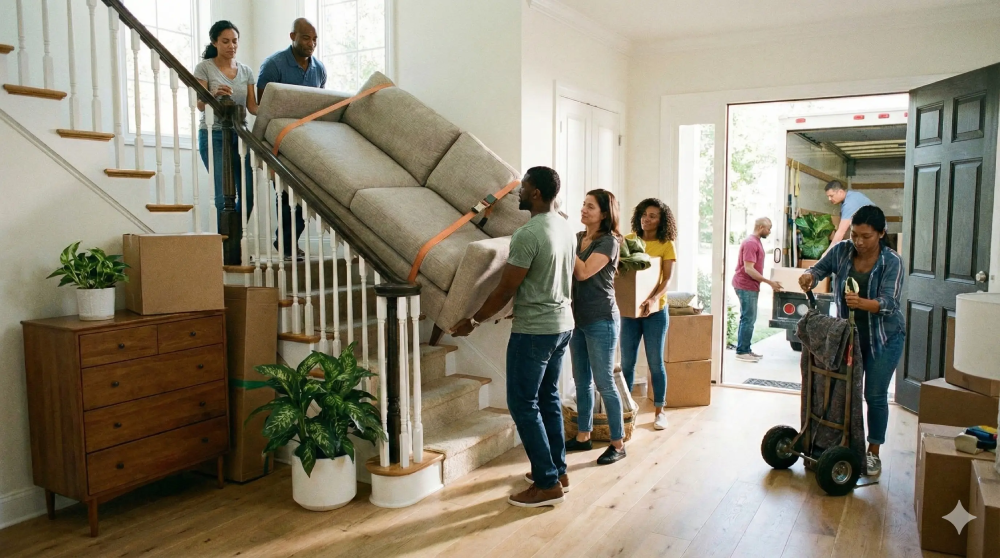
Stairs represent the single biggest time multiplier in any moving estimate, adding about one hour per flight regardless of crew size. This isn't simply walking time. Movers must slow their pace for safety, take more frequent breaks, and use specialized techniques for navigating turns.
A third-floor apartment move typically adds two to three hours compared to an identical ground-floor unit, making stairs the factor most people underestimate when planning their move timeline.
Carry distance creates another significant time increase that surprises even experienced movers. The impact breaks down as follows:
- Under 20 feet: negligible time added.
- 20-50 feet: adds 30-60 minutes to your total move.
- Over 50 feet: adds one to two hours (common in apartment complexes with distant parking or homes with long driveways).
Urban moves with street parking two blocks away can double your estimated time, especially when combined with stairs or elevator waits.
Drive time between locations affects more than just travel duration. The crew must secure the load, navigate to the new location, find parking, and potentially wait for building access. Distance directly impacts your timeline in predictable ways:
- 10-40 miles: adds at least 30 minutes beyond actual drive time.
- 40-75 miles: typically adds one to two hours.
- 75-100 miles: requires two to three additional hours.
These estimates include necessary breaks and the reality that loaded trucks move slower than regular vehicles.
Choosing the Right Crew Size for Your Move
Adding movers reduces clock-time but not always proportionally, making crew size decisions more complex than simple math suggests. Understanding the best crew size for your specific situation helps balance speed against cost.
Two movers work well for smaller spaces where additional people would create congestion, typically handling studio to two-bedroom apartments efficiently. Three movers hit the sweet spot for most residential moves, reducing time by 25-40% compared to two movers while maintaining coordination. Four or more movers only make sense for homes over 2,500 square feet or when time constraints demand speed.
Physical bottlenecks determine whether extra movers actually save time or simply increase your labor costs. Narrow staircases, small elevators, and single-door access points create natural limitations where only one or two people can work simultaneously.
A fourth mover might reduce loading time at a spacious suburban home but provide minimal benefit in a compact city apartment. Consider your specific layout constraints before assuming more movers automatically means faster completion, as coordination overhead can actually slow progress in confined spaces.
Why Loading and Unloading Times Often Differ
Unloading typically takes 20-30% longer than loading despite involving the same items and crew, a reality that catches many people off guard. During loading, movers can stage items efficiently near the truck and work in a systematic flow. Unloading requires navigating an unfamiliar layout, making placement decisions room by room, and often backtracking when customers change their minds about furniture positioning. The mental fatigue from earlier loading work also slows the unloading pace.
Assembly requirements and placement precision further extend unloading time beyond initial estimates. Beds need reassembly, furniture requires careful positioning, and boxes must reach their designated rooms rather than simply leaving the truck. Customers often discover they want to rearrange layouts once they see furniture in the new space, adding unplanned repositioning time. Multi-story destinations amplify these delays, as movers must learn new stairway configurations and room layouts while managing accumulated fatigue from the day's earlier work.
Real-World Moving Scenarios and Time Calculations
Example 1: One-Bedroom Apartment Move
An 800-1000 square foot apartment with two movers, one flight of stairs, and 20-50 foot carry distance typically requires 3.5-4 hours total.
Time breakdown:
- Base time: 2 hours.
- Stairs: +1 hour.
- Moderate carry distance: +30 minutes.
The resulting 7-8 labor-hours of work translates to roughly $175-$200 for labor-only services or $400-$500 for full-service movers. For a detailed comparison of these options, see our guide on moving yourself vs. hiring movers.
Example 2: Medium Family Home Relocation
A 1,800 square foot home with three movers, moving 40-75 miles with 50+ foot driveway access and one flight of stairs calculates to 6-9 hours.
Time breakdown:
- Base time: 3-4 hours.
- Drive time: +1-2 hours.
- Stairs: +1 hour.
- Long carry distance: +1-2 hours.
This 18-27 labor-hour job would cost $450-$675 for moving help or $1,200-$1,800 for traditional movers. To understand the full cost breakdown, check out how much it costs to hire a moving company.
Example 3: Large Home with Multiple Challenges
A 3,500 square foot home using four movers, with two flights of stairs and 50+ foot carry distance, represents 7-9 clock-hours minimum.
Time breakdown:
- Base time: 4-5 hours.
- Stairs (two flights): +2 hours.
- Distance complications: +1-2 hours.
These 28-36 labor-hours would run $700-$900 for labor-only assistance, while full-service companies might charge $2,000-$3,000 for the complete package including their truck and insurance.
How To Reduce Your Moving Labor Hours
Pre-move preparation saves more time than any other factor within your control. The right preparation can reduce your total moving time by 30% or more.
Preparation steps that save time:
- Pack and label all boxes completely before movers arrive.
- Stage boxes near the exit door to eliminate repeated trips.
- Disassemble furniture yourself (saves 15-20 minutes per piece).
- Clear pathways and remove door hinges on tight corners.
- Place floor protection in advance.
If you're unsure whether professional packing services make sense for your situation, our article on whether movers pack for you can help you decide.
Reservation logistics prevent costly delays that can double your actual move time. Small administrative oversights often cause the biggest time losses.
Logistics to handle in advance:
- Reserve elevator time in 2-3 hour blocks to avoid sharing with neighbors.
- Secure parking permits for the closest possible loading zone.
- Confirm your truck rental the day before to avoid morning delays.
- Have payment ready to eliminate administrative delays.
These preparations often make the difference between finishing within estimate versus paying overtime rates for extended service. Before hiring any moving company, review our guide on questions to ask movers to make sure you're fully prepared.
Mastering Your Moving Timeline and Labor Estimates
The difference between a smooth move and a stressful one often comes down to accurate time estimation. Remember that stairs add roughly one hour per flight, long carry distances can add up to two hours, and unloading typically takes 20-30% longer than loading. Your best defense against time overruns is systematic preparation. Pack everything beforehand, stage boxes near exits, and secure elevator reservations and parking permits in advance. These steps alone can cut your moving time by 30%.
Always add a 20% time buffer to your baseline estimate. Moving complexity compounds in ways that even experienced movers struggle to predict, and finishing early beats scrambling for extensions at overtime rates. For more insights on planning your move effectively, including the best timing, see our guide on the best time to move. If you're ready to get a personalized estimate based on your specific move requirements, try our interactive moving labor hours calculator to see exactly what your move will require in terms of time, crew size, and budget.
Frequently Asked Questions
Can I reduce crew size mid-move to save money?
No, reducing crew size mid-move isn't possible and would extend your total time, increasing costs.
How do I estimate hours for a partial home move?
Calculate based on the specific rooms you're moving rather than total home size, then apply the same stairs and distance adjustments.
Do different seasons affect moving time estimates?
Summer heat adds 10-15% to moving time, while winter conditions with snow or ice can add 20-30%.
How accurate are these estimates for apartments versus houses?
Apartment estimates are more accurate due to standardized layouts, while houses vary more due to basements, garages, and yard equipment.
What's the time difference between loading pods versus trucks?
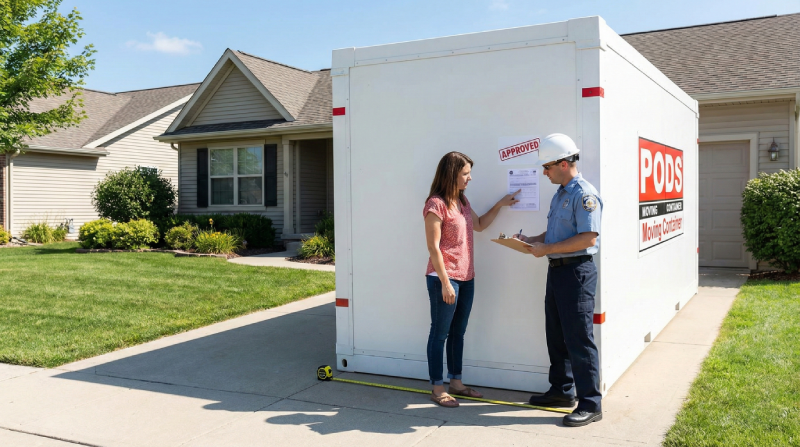
Portable storage containers require 20-30% more time due to tighter packing requirements and weight distribution concerns.









.webp)